
ERP for Toy Manufacturing Industry: Manage Components, Assembly and Finished Goods
Your toy factory is receiving orders. Production is running. Sales are growing. But are your manufacturing operations becoming more profitable?
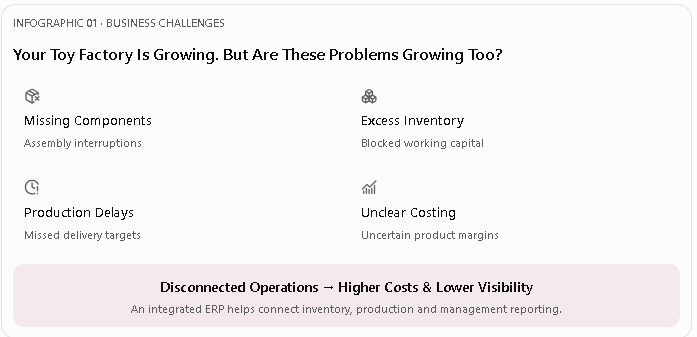
For many toy manufacturing business owners, growing sales do not always translate into stronger profit margins.
A factory may have sufficient raw materials but still face assembly delays because one critical component is unavailable. Production teams may complete hundreds of toys, while management struggles to understand the actual manufacturing cost per unit. Meanwhile, finished goods continue accumulating in the warehouse, tying up working capital.
These are not simply production-floor problems. They directly affect profitability, customer commitments, cash flow, and business growth.
This is where ERP for Toy Manufacturing Industry becomes relevant.
By connecting component purchasing, inventory, production planning, assembly, quality checks, and finished goods management, an integrated ERP system gives manufacturers better control over the entire production cycle.
For CEOs and business owners, the value is not just automation. It is the ability to make better decisions using more reliable operational information.
Why Growing Toy Manufacturers Need Better Operational Control
Toy manufacturing is a component-driven business.
Whether a company produces plastic toys, educational toys, electronic toys, wooden puzzles, or battery-operated products, manufacturing involves several interconnected activities.
Each product may require multiple materials, purchased components, assembly operations, inspections, and packaging processes.
As the business grows, managing these activities becomes increasingly challenging.
Consider a manufacturer producing 10 different toy models, each available in several colours or configurations.
The business needs to coordinate component availability, customer demand, production schedules, supplier deliveries, manufacturing costs, and finished product inventory.
When departments depend on separate spreadsheets and manual reporting, management may not receive accurate information at the right time.
The Business Impact of Disconnected Operations
Component shortages: Production can stop even when most materials are available.
Excess inventory: Unused components may remain in storage while working capital stays blocked.
Production delays: Poor coordination between purchasing and assembly can affect customer delivery commitments.
Unclear product profitability: Management may know the selling price but lack visibility into actual manufacturing costs.
Finished goods discrepancies: Warehouse stock may not match production or sales records.
These problems become more expensive as order volumes and product variants increase.
Implementing toy manufacturing ERP software can help connect departments, improve information accuracy, and support more disciplined manufacturing operations.
1. Component Inventory Management: Protect Your Working Capital
For a toy manufacturing business, inventory is more than a warehouse responsibility. It represents money invested in materials and components.
Plastic bodies, wheels, motors, screws, electronic circuits, batteries, packaging materials, and other components must be purchased before they become finished products.
If components are purchased too early or in excessive quantities, working capital becomes tied up in inventory.
If materials are purchased too late, assembly operations may stop.
Both situations affect business performance.
How ERP Helps Business Owners
With suitable toy component inventory management, manufacturers can improve visibility into:
Available component stock
Materials reserved for production
Pending purchase orders
Components required for upcoming manufacturing orders
Inventory movements and stock valuation
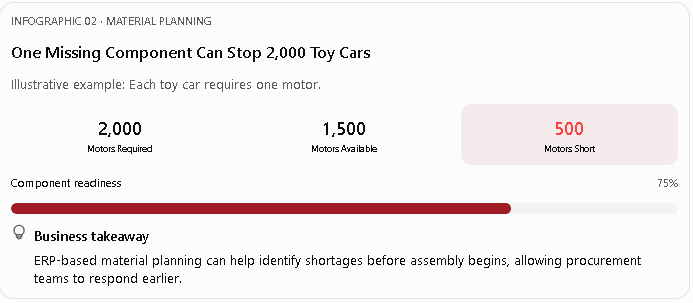
Consider a toy manufacturer that receives a confirmed order for 5,000 battery-operated cars.
The warehouse may have sufficient wheels and plastic bodies but only enough electric motors for 3,000 cars.
With an integrated inventory and manufacturing system, the shortage can be identified during material planning rather than after assembly begins.
This allows the purchasing team to take action earlier.
The Business Advantage
Better inventory visibility helps manufacturers reduce unnecessary purchases, improve material availability, and manage working capital more effectively.
For a CEO, the important question is not simply, "How much inventory do we have?" It is, "How much of our inventory can actually support confirmed production and customer orders?"
2. BOM Management: Know What Every Toy Really Requires
Imagine manufacturing 5,000 toy cars.
Each toy requires a plastic body, four wheels, a motor, a battery holder, screws, and packaging.
If the component requirements are not clearly defined, purchasing and production teams may make inconsistent estimates.
That can lead to shortages, excess purchasing, or inaccurate manufacturing costs.
A Bill of Materials (BOM) solves this problem by defining the components and quantities required for a finished product.
Example: Material Requirements for a Toy Car
| Component | Quantity per Toy | Requirement for 5,000 Toys |
|---|---|---|
| Plastic Body | 1 | 5,000 |
| Wheels | 4 | 20,000 |
| Electric Motor | 1 | 5,000 |
| Battery Holder | 1 | 5,000 |
| Screws | 6 | 30,000 |
| Packaging Box | 1 | 5,000 |
Illustrative example before considering available stock, scrap allowances, and other production demand.
With BOM management for toy manufacturing, businesses can maintain standard component requirements for different toy models.
It also helps production teams calculate material needs when customer orders increase.
For complex products such as electronic toys, multi-level BOMs can represent subassemblies and their components.
Why BOM Accuracy Matters to Management
Accurate BOMs support three important business decisions:
Purchasing: How many components need to be purchased?
Production: Are all required materials available to manufacture the order?
Costing: What is the expected material cost of each toy?
Instead of depending on informal estimates, management can work with structured product information.
3. Assembly Production: Identify Delays Before They Affect Delivery
In toy manufacturing, having materials available does not automatically mean the factory can deliver on time.
Assembly requires coordination between multiple production activities.
Depending on the toy category, the workflow may involve moulding, component preparation, painting, fitting, wiring, testing, and packaging.
When one process is delayed, subsequent operations may also be affected.
A Typical Toy Manufacturing Workflow
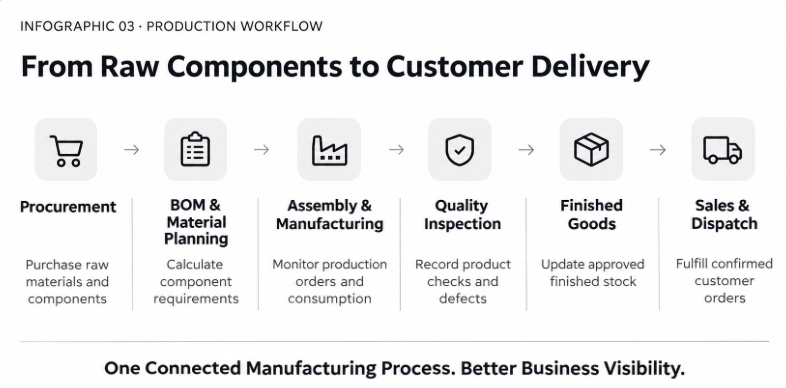
A configured toy assembly management software solution can help manufacturers manage production orders and monitor relevant manufacturing activities.
For business owners, this means better visibility into what is happening across the factory.
Instead of relying entirely on verbal updates, managers can review recorded order quantities, material availability, and production progress.
Business Questions ERP Can Help Answer
Which manufacturing orders are currently in progress?
Which orders are waiting for components?
How many finished units have been recorded?
Which production orders are delayed?
Which products are ready for the next operation or dispatch?
The answers depend on timely shop-floor data entry and the manufacturing workflows configured in the ERP system.
The Business Advantage
Better production visibility helps management identify operational problems earlier and coordinate resources more effectively.
For companies managing several toy models simultaneously, this can become an important factor in meeting customer delivery commitments.
4. Production Planning: Manage Growth Without Increasing Operational Confusion
Toy manufacturing businesses may experience sudden increases in demand during festive seasons, promotional campaigns, or large distributor orders.
Higher demand creates opportunities for revenue growth, but it also increases operational pressure.
A manufacturer receiving orders for multiple toy categories must coordinate purchasing, component availability, production schedules, and warehouse capacity.
Without structured planning, urgent purchasing, production changes, and missed commitments can become frequent problems.
Toy production management software can help businesses connect manufacturing requirements with inventory and procurement information.
From Customer Orders to Manufacturing Requirements
Suppose a manufacturer receives confirmed orders for:
5,000 plastic toy cars
3,000 educational building kits
2,000 battery-operated robots
Each product has different components, production requirements, and assembly processes.
An ERP-based planning process can help evaluate material requirements across manufacturing orders and identify potential component shortages.
Where supported, manufacturing and work-centre planning can also help organize production activities.
Why This Matters for Business Owners
Production planning is closely connected to working capital, labour utilization, procurement expenses, and customer satisfaction.
Better planning supports more consistent production decisions and helps reduce avoidable operational disruptions.
Growing production capacity is valuable. But improving how effectively existing capacity is used can be equally important for profitability.
5. Manufacturing Cost Control: Are You Selling Every Toy at the Right Margin?
One of the most important questions for a manufacturing CEO is:
"Do we know the actual cost of manufacturing each product?"
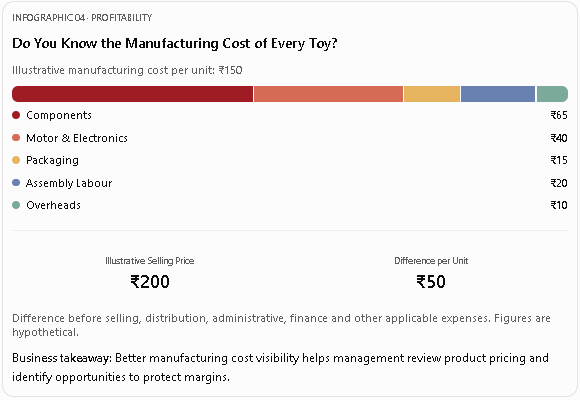
Many businesses can calculate an estimated cost using component purchase prices.
However, the complete manufacturing cost may also include labour, packaging, machine expenses, production losses, and allocated overheads.
When these expenses are not properly recorded, management may make pricing decisions using incomplete information.
Example: Manufacturing Cost of a Toy Car
| Cost Component | Cost per Unit |
|---|---|
| Plastic Body and Components | ₹65 |
| Motor and Electrical Parts | ₹40 |
| Packaging | ₹15 |
| Direct Assembly Labour | ₹20 |
| Allocated Manufacturing Overheads | ₹10 |
| Total Manufacturing Cost | ₹150 |
Illustrative figures only; actual costs depend on the product and factory.
Suppose the company sells the toy to a distributor for ₹200.
The difference between the selling price and the illustrated manufacturing cost is ₹50 per unit, before considering other expenses such as selling, distribution, administration, financing, and applicable taxes.
If actual component consumption or assembly expenses increase, that margin can shrink.
How ERP Supports Better Cost Decisions
With appropriate toy manufacturing cost control workflows, businesses can review component consumption, inventory valuation, and relevant manufacturing expenses.
Depending on the system configuration, planned costs can be compared with recorded actual costs.
This helps management investigate questions such as:
Which toy models consume more materials than expected?
Are component purchase price increases affecting margins?
Are production losses increasing?
Which products require cost or selling-price reviews?
The value of ERP is not only calculating costs. It is making cost information available for better management decisions.
6. Quality Control: Reduce the Business Risk of Defective Products
A defective toy can create more than a manufacturing loss.
Depending on the issue, it may lead to customer complaints, rejected shipments, product returns, rework expenses, or regulatory concerns.
For toy manufacturers, quality control should be part of the manufacturing process rather than an activity performed only before dispatch.
Quality Checks Across the Production Cycle
Incoming Material Inspection: Evaluate relevant purchased components and materials.
Assembly Inspection: Identify fitting, functional, and workmanship defects.
Final Product Inspection: Verify applicable product and packaging requirements before release.
Where suitable quality functionality is configured, ERP can help maintain inspection records, defect information, rejected quantities, and associated production details.
This improves record visibility and supports investigations when quality issues occur.
Toy Safety Compliance in India
Toy manufacturers selling products in India should evaluate the applicable Bureau of Indian Standards (BIS) requirements and other relevant product safety obligations.
ERP systems can support quality documentation and traceability, but they do not replace mandatory testing, certification, or independent compliance verification.
The Business Advantage
Structured quality records help management identify recurring issues and support corrective action.
Better quality processes can also protect customer relationships and reduce avoidable rework.
7. Finished Goods Management: Stop Losing Visibility After Production
For many manufacturing businesses, production reporting and warehouse stock reporting are not always synchronized.
A factory may complete 2,000 toys, but the sales team may not immediately know how many are available for customer delivery.
Some quantities may still require inspection, packaging, or internal stock transfers.
This lack of visibility can affect order fulfilment and customer commitments.
With integrated finished goods inventory management, manufacturers can connect completed production quantities with warehouse stock and sales operations.
Better Stock Visibility
ERP can help maintain stock information by product, SKU, variant, and warehouse location.
Improved Sales and Dispatch Coordination
Sales teams can review relevant inventory availability when processing orders, subject to access controls and stock reservation rules.
Control Over Product Variants
A toy manufacturer producing different colours, designs, or packaging variations can maintain suitable SKU-level inventory records.
Improved Inventory Reconciliation
Integrated stock movements can make it easier to investigate differences between production, warehouse, and dispatch records.
For business owners, finished goods visibility is ultimately about converting completed production into customer deliveries without unnecessary delays.
8. ERP vs Manual Processes: What Changes for Toy Manufacturers?
As a toy manufacturing company grows, the cost of disconnected information becomes more noticeable.
The following comparison shows how integrated ERP workflows can improve operational visibility.
| Business Area | Manual or Disconnected Processes | Integrated ERP Approach |
|---|---|---|
| Component Inventory | Separate registers and spreadsheets | Centralized stock records |
| Material Planning | Manual component calculations | BOM-based requirements planning |
| Production Tracking | Department-wise updates | Manufacturing order visibility |
| Assembly Management | Informal progress reporting | Structured production records |
| Product Costing | Spreadsheet-based estimates | Integrated material and cost information |
| Finished Goods | Separate warehouse records | Connected production and inventory movements |
| Management Reporting | Consolidation from multiple sources | Centralized operational reporting |
Actual functionality depends on the selected ERP platform, implementation scope, and configured workflows.
ERP is not a substitute for disciplined factory operations.
However, when combined with accurate master data, appropriate processes, and trained users, it can provide a stronger foundation for manufacturing management.
9. When Should a Toy Manufacturing Company Consider ERP?
Not every manufacturer needs to replace its existing systems immediately.
However, certain business conditions indicate that integrated manufacturing software may be worth evaluating.
Consider reviewing your current systems if:
Component shortages frequently interrupt assembly.
The purchasing and production teams maintain different stock records.
Manufacturing involves numerous product models and variants.
Product costing depends heavily on manual estimates.
Management struggles to obtain accurate production updates.
Finished goods availability is difficult to reconcile.
Increasing sales volumes are creating more operational complexity.
If several of these challenges are affecting your business, evaluating ERP software for toy manufacturers in India may be a practical next step.
The objective should not be to introduce more technology for its own sake.
It should be to improve control over the processes that affect profitability, delivery performance, and future growth.
10. How Primacy Infotech Can Help Toy Manufacturers
Every toy factory operates differently.
A plastic toy manufacturer using injection moulding may require different production workflows from a company assembling electronic educational toys or manufacturing wooden products.
That is why ERP implementation should begin with understanding the business process.
Primacy Infotech provides Odoo ERP consulting, implementation, and manufacturing process solutions.
Our PriERP platform, built on Odoo Community and enhanced with Primacy-developed applications and workflows, brings together essential business functions such as purchasing, inventory, manufacturing, sales, accounting, and reporting.
For toy manufacturing businesses, our team can assess requirements involving component inventory, BOM management, production orders, assembly workflows, manufacturing costs, and finished goods management.
Specialized requirements can be evaluated for configuration or customization based on the selected solution and approved implementation scope.
Is Your Factory Ready for Better Manufacturing Visibility?
If your business is growing but component shortages, assembly delays, inventory discrepancies, or unclear production costs are affecting operations, it may be time to review your manufacturing processes.
Book a Free ERP Consultation with Primacy Infotech.
Discuss your current manufacturing challenges and explore how an integrated ERP solution could support your business.
Website: https://primacyinfotech.in/
Explore PriERP: https://prierp.com/
Frequently Asked Questions (FAQs)
1. What is ERP for Toy Manufacturing Industry?
ERP for Toy Manufacturing Industry is an integrated business management solution that connects key processes such as component purchasing, inventory, BOM management, manufacturing, assembly, finished goods, and financial reporting.
2. How does ERP software improve profitability in toy manufacturing?
ERP can improve visibility into inventory, material consumption, production activities, and relevant manufacturing costs. This helps management identify inefficiencies and make better-informed purchasing, production, and pricing decisions.
3. Can ERP software help reduce component shortages?
Yes. When accurate BOMs, inventory records, and planning rules are maintained, ERP can help identify component requirements and potential shortages before manufacturing begins.
4. Is ERP suitable for small and medium-sized toy manufacturers?
Yes. Growing toy manufacturers can benefit from connected inventory, purchasing, manufacturing, and reporting processes. The appropriate implementation depends on business size, production complexity, available budget, and operational requirements.
5. Can ERP manage different toy models, colours, and variants?
Many ERP platforms support product variants and SKU-level inventory management. Specific manufacturing and costing requirements for different variants should be evaluated during implementation.
6. How does ERP help management track toy production?
ERP can provide visibility into manufacturing orders, material consumption, completed quantities, and relevant production activities. Detailed shop-floor tracking depends on the available features, configuration, and data recording practices.
Conclusion: Better Manufacturing Control Supports Better Business Growth
Toy manufacturing is becoming increasingly complex as businesses expand their product ranges, customer networks, and production volumes.
For CEOs and business owners, sustainable growth requires more than increasing output.
It requires control over component inventory, manufacturing costs, assembly operations, product quality, and finished goods.
Implementing ERP for Toy Manufacturing Industry can help connect these activities and improve operational visibility across the business.
The real objective is simple: reduce avoidable operational uncertainty, make better decisions, and build a manufacturing business that can scale with greater control.
Ready to improve visibility across your toy manufacturing operations?
Connect with Primacy Infotech for an ERP consultation and explore a solution aligned with your factory's requirements.